Calculus I · The Slope of a Single Point
The derivative is a function
Look back at what we found: held for every value of . So the derivative isn’t really a single number attached to one point — it’s a rule that takes any point and returns the slope there. That rule is itself a function, and we write it with the variable :
This reframe is bigger than it looks, and the rest of the book depends on it. The derivative of is a new function , which you can then graph, evaluate, or differentiate again (giving , the second derivative — the star of Chapters 7 and 8). The derivative is not just an answer; it’s an object you can keep working with.
A word on notation, because you’ll see two styles everywhere. Lagrange’s is compact — “ prime of .” Leibniz’s or keeps the idea of the difference quotient visible: it’s the limit of (change in output over change in input) as the changes shrink to nothing. The symbol all by itself is read as an operator — “take the derivative with respect to of whatever comes next.” Both names mean the identical thing; we’ll use whichever is clearer, and you should grow comfortable with both. (Leibniz’s notation will earn its keep especially in Chapter 4’s chain rule, where it almost does the thinking for you.)
The most physical version: velocity
The reason this idea felt urgent to the people who invented it was motion. Let be the position of a moving object at time . Over a time interval, its average speed is (change in position)/(change in time) — a difference quotient. Shrink the interval to an instant, and you get the instantaneous velocity: the number on the speedometer, the rate of change of position right now.
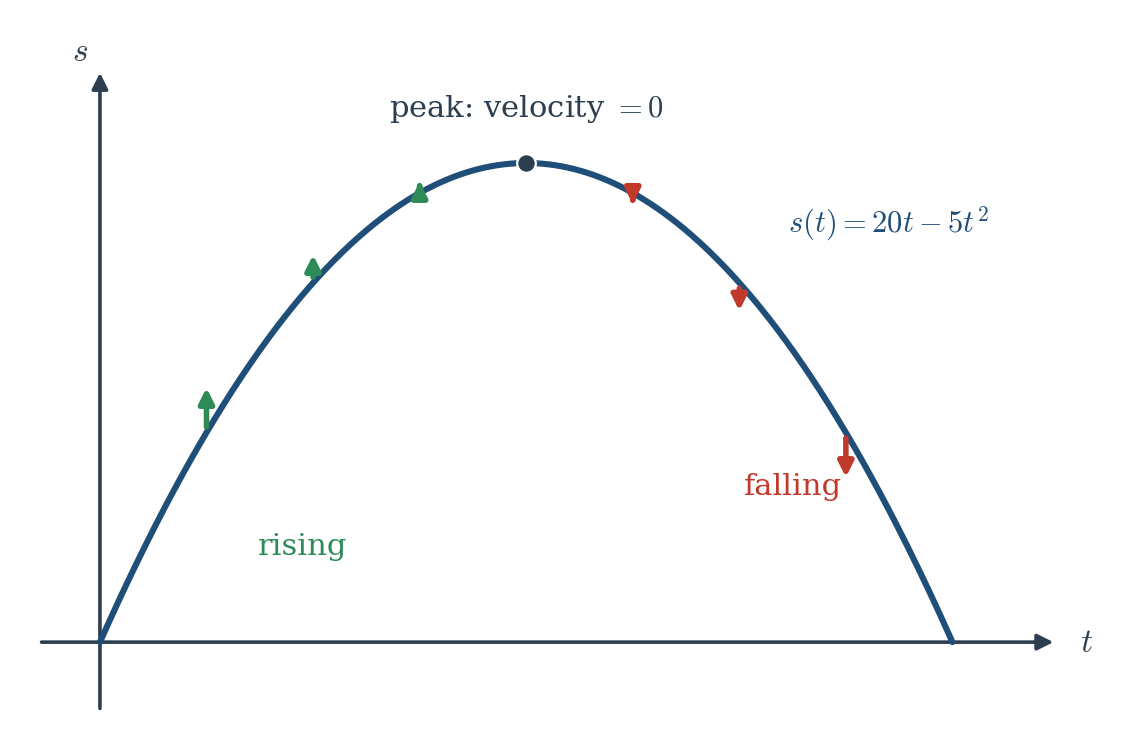
Worked example — a thrown ball. Throw a ball straight up, and (ignoring air, with gravity rounded to ) its height after seconds is meters. Its velocity is the derivative — which we compute the only way we know, from the definition:
so . At launch () the ball rises at ; the velocity drops steadily; and at it hits — the ball is momentarily not moving, which is exactly the top of its flight, the instant before it falls back. Hold onto that: the highest point is where the velocity (the derivative) is zero. That is your first glimpse of Chapter 8, where every maximum and minimum is found by setting the derivative to zero. (Figure 3.3: the height curve as an arch, with the velocity arrows shrinking to zero at the peak and reversing after.)