Calculus I · The Slope of a Single Point
The tangent line: a function’s best straight-line stand-in
The derivative hands you the slope of the tangent at , and with a slope and a point you can write the tangent line:
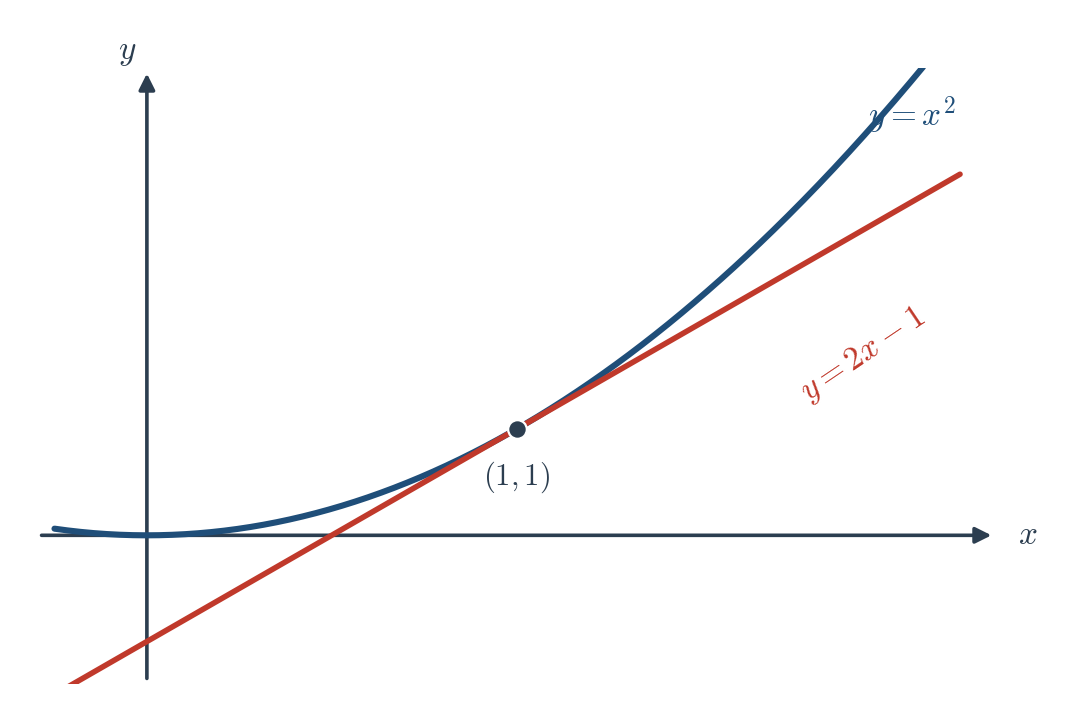
Example. The tangent to at : here and , so the line is . Near , the curve and the line are almost indistinguishable.
That “almost indistinguishable near ” is a profound idea in disguise, and we’ll name it fully in Chapter 7: the tangent line is the best straight-line approximation of a curve near a point. Zoom in on any smooth curve far enough and it looks straight — and the straight line it looks like is the tangent, whose slope is the derivative. To know a function’s derivative at is to know the simplest possible model of it right there.
◆ Layer 2 — When a function has no slope, and what that has to do with Chapter 2
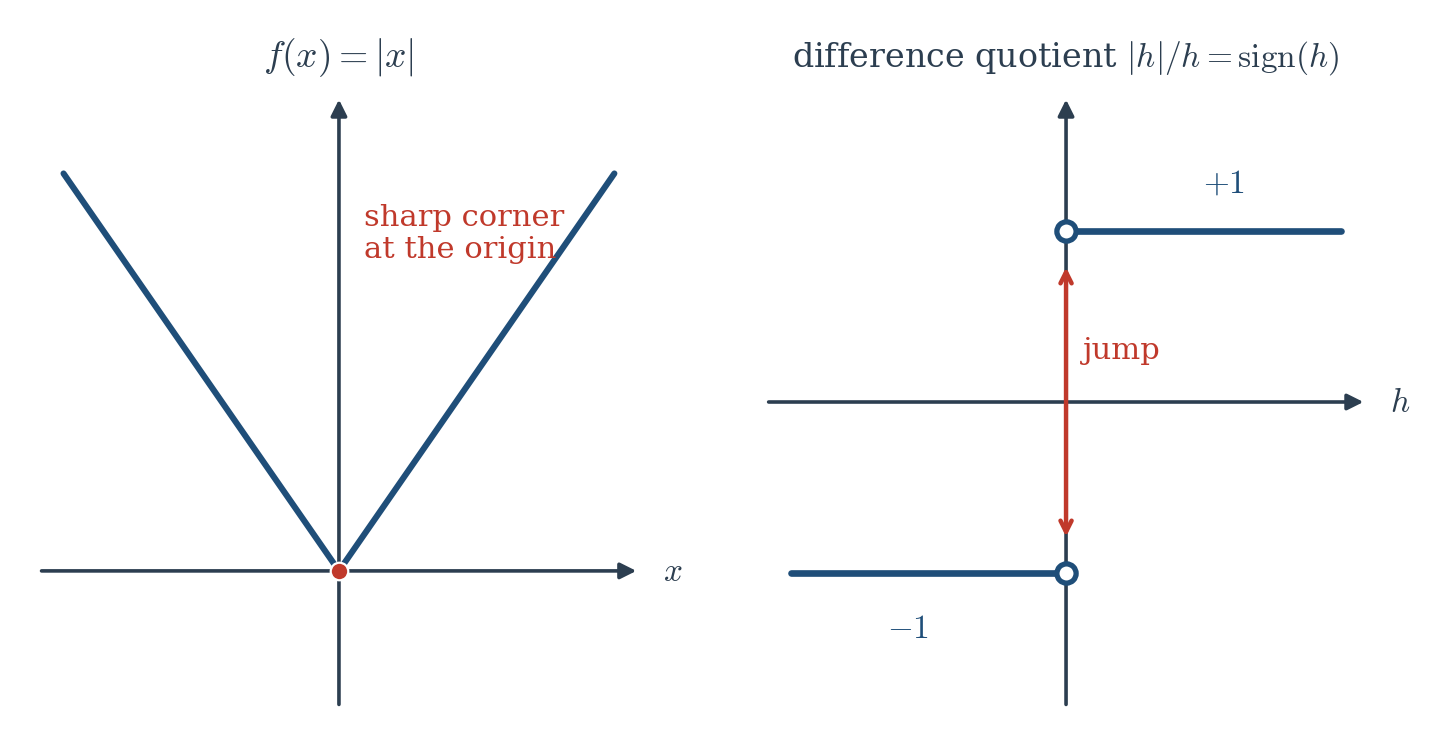
The derivative is a limit, and limits don’t always exist — so neither do derivatives. The cleanest example is one you already know the shape of: at . It’s a perfectly continuous function (you can draw it without lifting your pen), but it has a sharp corner at the origin, and a corner has no single slope. Watch the difference quotient confirm it. At , the quotient is , which is the sign function from Chapter 2: - from the right (): ; - from the left (): .
The two one-sided limits disagree, so the two-sided limit — the derivative — does not exist. This is exactly the jump from Chapter 2, reappearing as the slope of . The corner of one graph is the jump of its derivative.
So differentiability is genuinely stronger than continuity — every differentiable function is continuous (proved below), but not every continuous function is differentiable. Corners (like ), cusps, and vertical tangents are all continuous-but-not-differentiable. This is the third floor of the “smoothness has consequences” story from Chapters 2 and 6, seen from below: differentiability asks for more than continuity, and a function can pass the first test and fail the second.
◆ Layer 2 — Proof that differentiable continuous
Suppose exists. We must show is continuous at , i.e. as . The trick is to write the change in as the difference quotient times : As , the first factor approaches the finite number and the second approaches , so the product approaches . Therefore : is continuous at . (The converse fails — is the counterexample — so “differentiable” sits strictly above “continuous.”)