Will you live to 120? · The Counting Problem
The pond, the yeast, and the Christmas gel
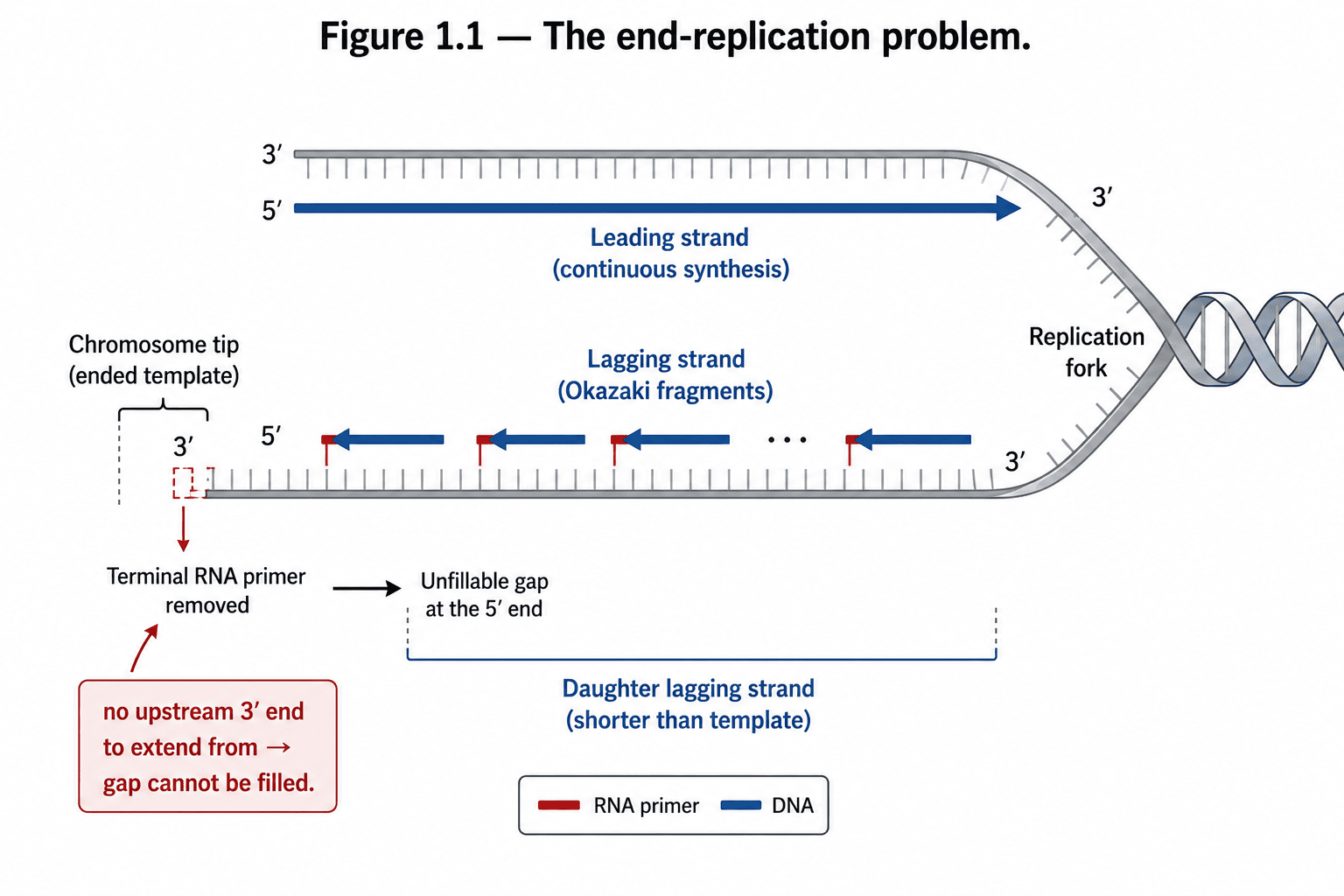
How fast does the end erode? Measurements put the loss at roughly fifty to a hundred base pairs per division in human cells — it varies with cell type and method; call the per-division loss bp. Human chromosome ends carry a buffer of repetitive DNA roughly eight to fifteen thousand base pairs long at birth — though it varies considerably from person to person and tissue to tissue. So the back-of-the-envelope number of divisions before that buffer is gone is
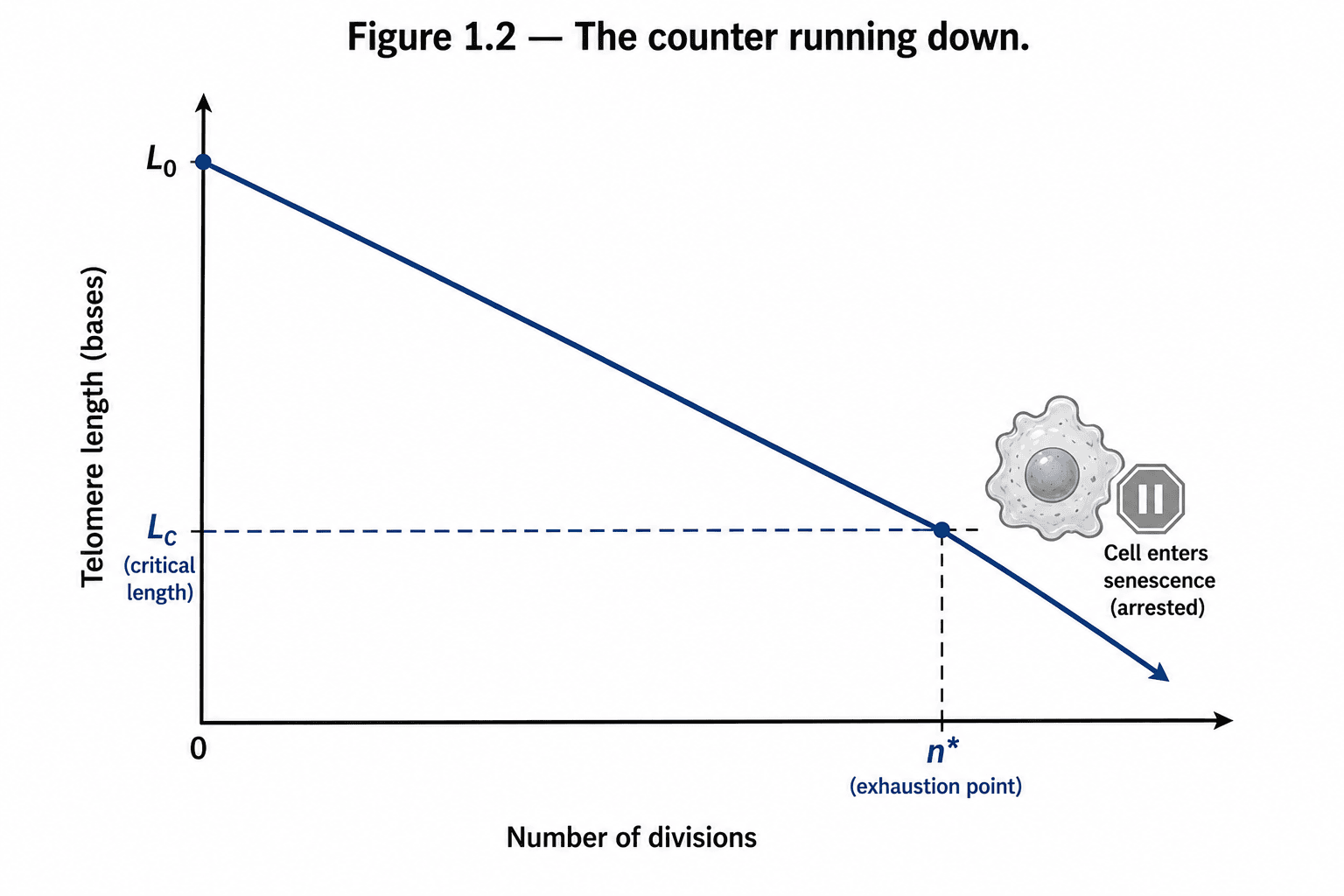
This is only a first approximation — real telomere loss is neither perfectly constant nor the whole story. And the Hayflick limit, in any case, is about fifty, not a hundred and thirty. The discrepancy is itself a clue: a cell does not wait for the buffer to hit zero. It retires when the buffer reaches a critical short length — a few thousand base pairs — that it senses as trouble. Model it simply. Let the buffer length after divisions be
and let be the critical length that triggers arrest. The cell retires after
Put in , , , and you get — the right neighborhood for the Hayflick limit. The real dynamics are noisier and not perfectly linear; the evidence suggests it is one or a few critically short telomeres, rather than the average length, that sound the alarm, and there is cell-to-cell scatter. But the linear model captures the essential logic, which is all we need here: a fixed buffer, eaten at a roughly fixed rate, runs out after a predictable number of divisions. That is the counter Hayflick was looking for. The tally is written in DNA, at the ends of the chromosomes, and it is counted down by the very act of copying.
Which raises an obvious worry. If the ends erode every time, why aren’t we losing genes with every cell division? Because the eroding ends are not genes. The last stretch of each human chromosome is a telomere: the six-letter sequence TTAGGG, repeated over and over — thousands of times — carrying no protein-coding information at all. It is a disposable buffer. And “disposable buffer” here is not a figure of speech dressed up as biology; it is the literal arrangement. The cell feeds meaningless repeats to the end-replication problem so that meaningful sequence sits safely upstream, untouched. Evolution did not solve the problem of un-copyable ends by fixing the copying. It solved it by putting something expendable at the end, to be lost on the cell’s behalf.
Deeper Water — the lagging strand, the overhang, and the cap. The end-replication gap is only half the reason chromosome ends shorten. After replication, nucleases chew the 5′ end back further to leave a single-stranded 3′ overhang — the very overhang the maintenance enzyme we are about to meet needs in order to work. There is also a subtler danger. A chromosome end looks, chemically, exactly like a double-strand break — the most lethal kind of DNA damage there is. If a cell treated its forty-six natural ends as forty-six breaks, it would try to “repair” them by fusing them together, scrambling the genome. It does not, because each telomere is wrapped in a six-protein complex called shelterin, which folds the 3′ overhang back and tucks it into the double-stranded telomere to form a lariat — the T-loop (worked out largely by Titia de Lange). The T-loop hides the end. So a telomere does two jobs at once: it is the buffer that absorbs the end-replication loss, and it is the disguise that stops the cell from reading its own chromosome ends as catastrophe. When a telomere grows too short to form the loop, the disguise fails, the end is read as a break, the DNA-damage response fires, and the cell shuts down. That, in molecules, is what “the counter ran out” actually means.
The pond, the yeast, and the Christmas gel
We have been talking about telomeres as if their existence were obvious. It was not. The story of how they were found is worth telling properly, partly because it is a good story and partly because of where the answers came from — none of them from anyone trying to cure aging.
It begins with two people staring at chromosomes through microscopes in the 1930s and 40s. Barbara McClintock, working on maize, noticed that when a chromosome broke, the broken ends were sticky — they fused readily with other broken ends. But the natural ends of an intact chromosome never did. So the natural ends had to carry something — some protective identity — that ordinary broken DNA lacked. Hermann Müller, working on fruit flies, saw the same thing and gave the structure its name in 1938, from the Greek telos (end) and meros (part): the telomere. Both were describing a function — end protection — decades before anyone knew what molecule performed it. (McClintock’s deeper work, on genes that jump around the genome, was so far ahead of its time that it was largely ignored; she finally won the Nobel for it in 1983, in her eighties.)
To go from “ends are special” to “ends are made of this,” you need ends — lots of them — and most organisms keep only a few dozen chromosomes per cell. Elizabeth Blackburn made a shrewd choice of material: a pond ciliate called Tetrahymena, which shreds its DNA into thousands of tiny chromosomes, and therefore thousands of telomere ends, per cell. In 1978 she sequenced those ends and found a simple repeat — TTGGGG — written over and over. A pattern at last. (Notice how close it is to the human TTAGGG: similar, not identical, a first hint that this is something ancient and shared across wildly different forms of life.)
All 10 chapters of Will you live to 120? · Foundations · All courses