Will you live to 120? · The Counting Problem
The brake and the price
Then came the decisive experiment, in 1982, when Blackburn teamed up with Jack Szostak. Szostak had been working with linear DNA plasmids in yeast, and the yeast kept destroying them — chewing them up from the ends. Blackburn handed him Tetrahymena telomere sequences; they stuck those sequences onto the ends of the plasmids; and the yeast stopped destroying them. Telomere repeats from a pond organism protected a piece of DNA inside an entirely different kingdom of life. That is the moment telomeres stopped being a quirk of one ciliate and became a universal functional element — the protection was portable across more than a billion years of evolution.
But the same experiment posed a new puzzle. In the yeast, the Tetrahymena ends not only survived; they had yeast-type repeats added onto them. Something was actively lengthening the ends — adding sequence to fight the erosion. There had to be an enzyme. Blackburn and her graduate student Carol Greider set out to find it.
Greider built an assay: a telomere-like primer, radioactive building blocks, an extract of cell innards, and a gel to separate whatever products came out. On Christmas morning in 1984 she developed the film and saw it — a regular ladder of bands, spaced six bases apart, exactly the signature of an enzyme adding telomere repeats one unit at a time. They had found telomerase. Greider was twenty-three.
The enzyme turned out to be stranger and more elegant than anyone expected. How does it know which sequence to add? It carries the answer inside itself. Telomerase is a ribonucleoprotein — a protein bound to a short RNA molecule — and that RNA contains a template matching the telomere repeat. The protein half is a reverse transcriptase: it reads its own internal RNA template and writes DNA from it, then ratchets forward and writes the same repeat again. The machine that maintains the ends of your chromosomes carries its own little ruler; the sequence to copy is built into the enzyme. (In the modern shorthand: TERT is the protein, TERC is the RNA.)
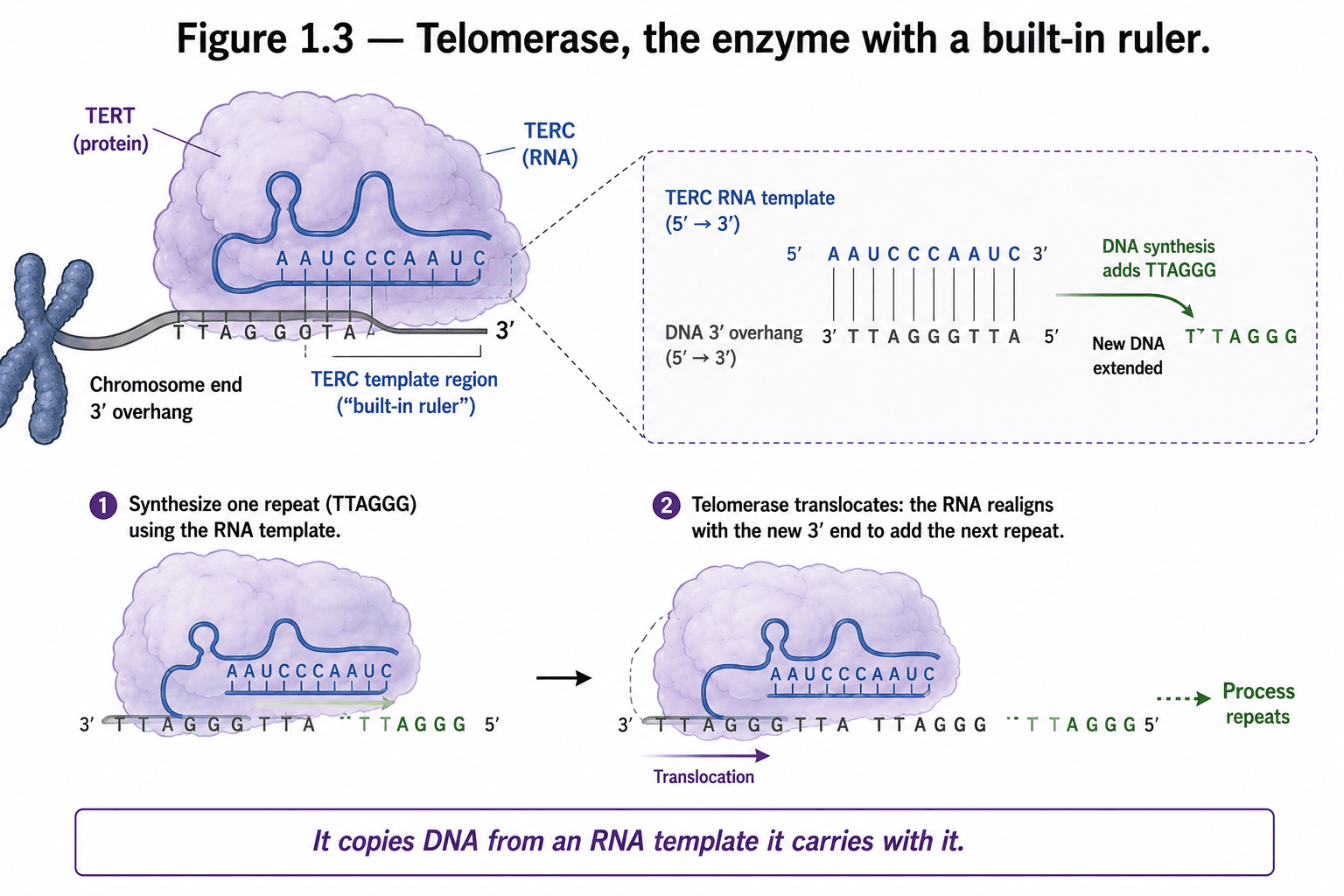
In 2009 the Nobel Prize in Physiology or Medicine went to Blackburn, Greider, and Szostak. Hold the shape of that story for a moment: a microscopic pond organism, a yeast plasmid, and a graduate student’s Christmas gel cracked a problem sitting at the very center of human aging and cancer. It is worth remembering the next time someone asks what possible use there could be in studying pond water.
The brake and the price
Now we can close Hayflick’s loop — and then immediately open a much sharper question.
Telomerase exists, and it can keep telomeres long indefinitely. Your germline cells — the lineage that makes eggs and sperm — keep it switched on, which is why your children do not inherit your worn-down telomeres; the counter is reset each generation. Many stem cells run it at a lower level too. But the great majority of your ordinary body cells switch telomerase off after development. With the enzyme gone, their telomeres shorten with every division, and after roughly fifty rounds a critically short telomere trips the DNA-damage response and the cell enters senescence — alive, still working, but permanently retired from dividing. In normal human fibroblasts, the Hayflick limit largely reflects telomere exhaustion, sensed as damage. Mystery solved.
But here is the question the rest of this book turns on. Telomerase is the cure for telomere shortening. Evolution invented it, kept it, and uses it in the germline. So why switch it off in the body at all? Why deliberately build in an aging clock you already know how to stop?
The answer is one of the most important ideas in all of aging biology. The Hayflick limit is a tumor suppressor. A cancer is, at bottom, a cell that divides when it shouldn’t, over and over, without limit. A cell that can divide only about fifty times has a built-in ceiling on how large a tumor it can build before it retires. The division counter is a brake on cancer. Turning telomerase off in your body cells is the price of that brake: your cells age, in part, precisely so that they cannot easily become immortal.
And we can confirm that this trade-off is real, not just a tidy story — because of what happens when cells do become cancer. The overwhelming majority of them switch telomerase back on. Roughly 85 to 90 percent of human cancers reactivate telomerase to escape the Hayflick limit and divide without end; most of the rest use a second, recombination-based route called ALT (alternative lengthening of telomeres). Defeating the telomere clock — immortalization — is one of the standard steps a normal cell takes on the road to malignancy.
So telomerase wears two faces at once. The same enzyme that would keep your cells young is the one your tumors must switch on to grow without limit. Aging and cancer are not opposites here; they are two ends of a single trade-off, and the telomere is the fulcrum. This is the first big idea to carry forward, and it generalizes far beyond telomeres: in aging biology, the obvious intervention is almost never free. “Just turn the clock back” usually means “remove a brake that was put there for a reason.” Hold that thought. It returns in every chapter.
Deeper Water — two barriers, and how cancer gets past both. Cells face not one telomere barrier to immortalization but two. The first is replicative senescence (sometimes labeled M1), triggered by short telomeres through the p53 and Rb pathways. A cell can be forced past it — for example by viral oncoproteins that disable p53 and Rb — but then it keeps dividing with telomeres that get dangerously short, and slams into the second barrier, crisis (M2): widespread end-to-end chromosome fusions, mangled cell divisions, and mass death. The rare cell that survives crisis has almost always done one specific thing — reactivated telomerase, or switched on ALT, to stabilize its ends. This is why telomerase reactivation is treated as a near-universal hallmark of cancer, and why telomere biology cuts both ways in medicine: too little maintenance and tissues fail early; too much and you have removed a barrier to malignancy. Note the therapeutic inversion this implies. The commercially hyped idea is to activate telomerase to fight aging. But the better-validated drug so far runs the opposite way — imetelstat, a telomerase inhibitor, has been approved for certain bone-marrow disorders, turning the enzyme off to starve abnormal cells. Switching telomerase off as a cancer therapy has reached the clinic. Switching it on as an anti-aging therapy has not.
The first thing almost everyone gets wrong
All 10 chapters of Will you live to 120? · Foundations · All courses