Will you live to 120? · The Counting Problem
When the clock really does break
Here the science meets the marketplace, and a careful reader has to slow down — because what follows is the single most transferable skill in this book. The same trap waits in every chapter to come.
The facts so far are seductive. Telomeres shorten as we age. People with shorter telomeres have, on average, higher rates of age-related disease and earlier death. String those two together and you arrive at a product: a blood test that measures your telomere length and reports your “true biological age,” usually paired with a supplement that promises to lengthen it. The pitch writes itself. It is also, at the level of the individual person buying it, close to useless. Understanding why is the point.
First, the number is noisy. The cheap and common way to measure telomere length is a method called quantitative PCR, which returns a ratio rather than an absolute length. It is fast and inexpensive, and it carries a large measurement error — split a single blood sample in two and measure both halves, and the two answers can disagree by more than a year’s worth of supposed “telomere age.” Better methods exist (the Southern blot of terminal restriction fragments; Flow-FISH), but they are slower, costlier, and still not pinpoint. So part of the biological age the test hands you is not your biology at all. It is the scatter of the assay.
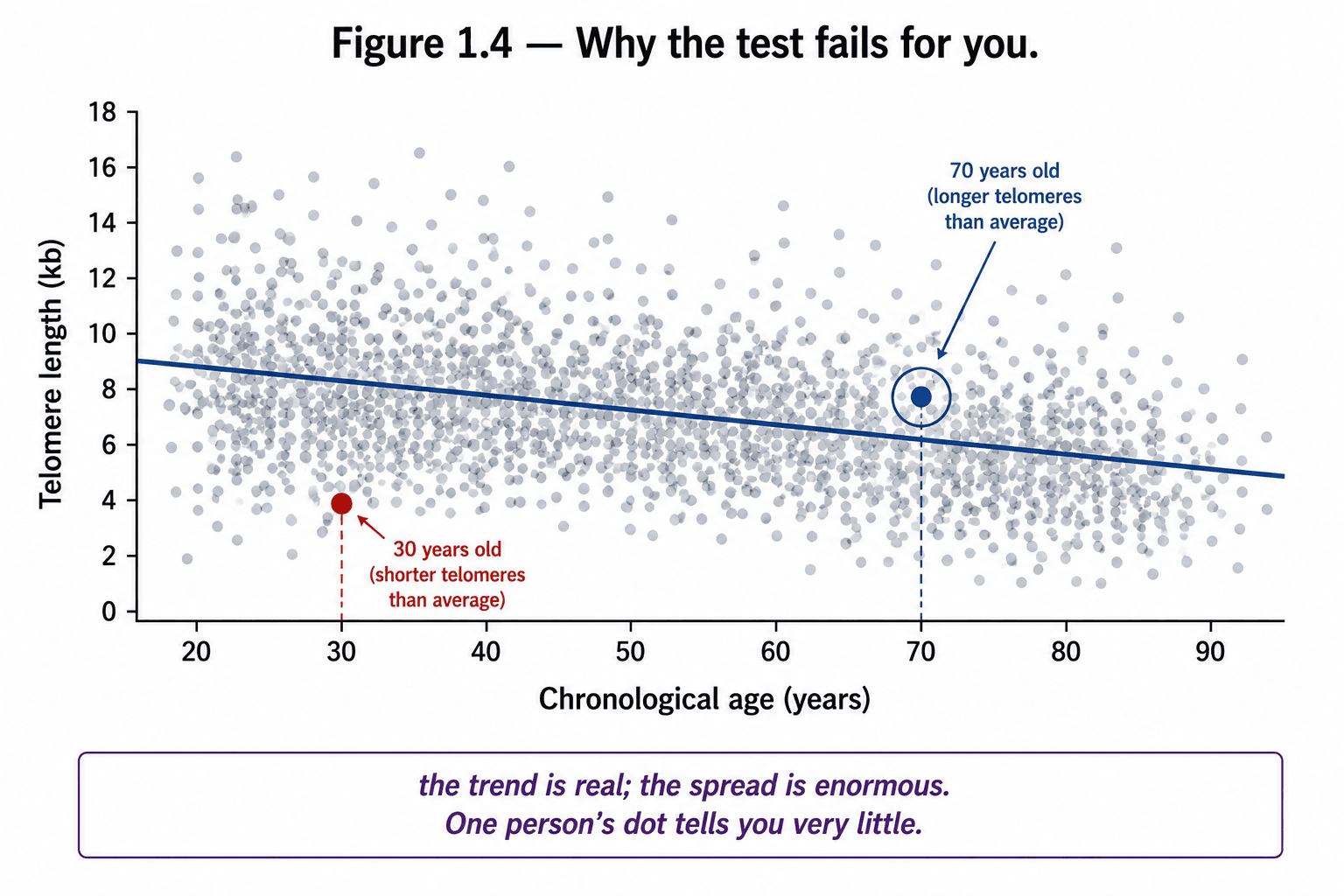
Second — and this is the deep one — a truth about a population is not a truth about a person. Across tens of thousands of people, average telomere length declines with age. That correlation is real and sturdy. But the spread at any given age is enormous. Among people who are all seventy, telomere lengths vary so widely that plenty of seventy-year-olds have longer telomeres than plenty of thirty-year-olds. Put a number on it. The correlation between age and telomere length in blood cells is real but modest — reported values of the correlation coefficient often fall in the range of roughly to , varying with the age range, the tissue, the assay, and the cohort. Square it:
That means telomere length accounts for only about ten to twenty-five percent of the variation in chronological age — and even less of the variation in the things you actually care about, like your own risk of heart disease, once age itself is taken into account. A variable can be unmistakably real in a population and still tell you almost nothing about the specific person in the chair. That gap — between a sturdy population average and a weak individual prediction — is the most important and most consistently ignored fact in all of consumer “biological age” testing.
Third, it is usually the wrong tissue, and a moving target. These tests measure telomere length in your white blood cells, because blood is what you can easily draw. But telomere behavior in immune cells need not match that in your heart muscle, your neurons, or your liver. And immune-cell telomere length is itself a moving target: a serious infection, chronic stress, or inflammation can expand and contract immune-cell populations and shift the reading — so the same person can test differently month to month for reasons that have nothing to do with how fast they are aging overall.
Fourth, cause or symptom? Even the link between short telomeres and disease is not cleanly causal. In many cases short telomeres may be a record of accumulated stress and inflammation rather than a driver of aging — a smoke detector going off, not the fire itself. Genetic studies that try to separate the two (Mendelian randomization, which uses inherited telomere-length variants as a kind of natural experiment) return a humbling result: genetically longer telomeres do lower the risk of some diseases — but they raise the risk of several cancers (melanoma, glioma, and certain lung cancers among them). Which is exactly what the brake-and-price trade-off predicted. Longer telomeres are not simply “better.” They are a different point on a trade-off — protective against some failures, permissive of others.
So what is telomere length, really? A genuine and important piece of aging biology, and a useful variable for research — for asking population questions across thousands of people. As a personal diagnostic you can buy and act on, it fails on four counts at once: the measurement is noisy, the individual prediction is weak, the tissue may be the wrong one, and “longer” is not unambiguously “better.” Two sentences are worth memorizing, because they are the discipline the rest of this book runs on:
“We can measure it” is not the same as “you should act on it.” And “it correlates with aging across a population” is not the same as "it tells you how you are aging."
You will need both most exactly where the marketing is loudest.
One nuance is worth holding here, because it sounds like a contradiction and isn’t. Longevity clearly runs in families. The children and siblings of people who reach a hundred tend to live longer than average, and telomere length itself is substantially heritable. Both are true. But “heritable across families” and “predictable for one individual from a single measurement” are different claims — the first can be strong while the second stays weak. Your family history is, in fact, one of the better long-range hints you have about your own aging. A one-time telomere readout from a mail-in kit is one of the worse ones. The biology is real; the test is still mostly noise.
When the clock really does break
All 10 chapters of Will you live to 120? · Foundations · All courses